The axon transmits signals via nerve impulses. Specifically, via a changing membrane potentials.
When a neuron is not firing, the voltage difference across the cell membrane of the axon is at rest. The potential at this stage is ~-70mV.
This potential is negative due to more cations leaving the cell than entering.
Action Potential
When a neuron wishes to transmit a signal via its axon, an action potential occurs. A stimulus causes the potential to increase above a threshold (typically -55mV).
Only stimuli causing an increase above the threshold will evoke a response. This is called the all or none principle.
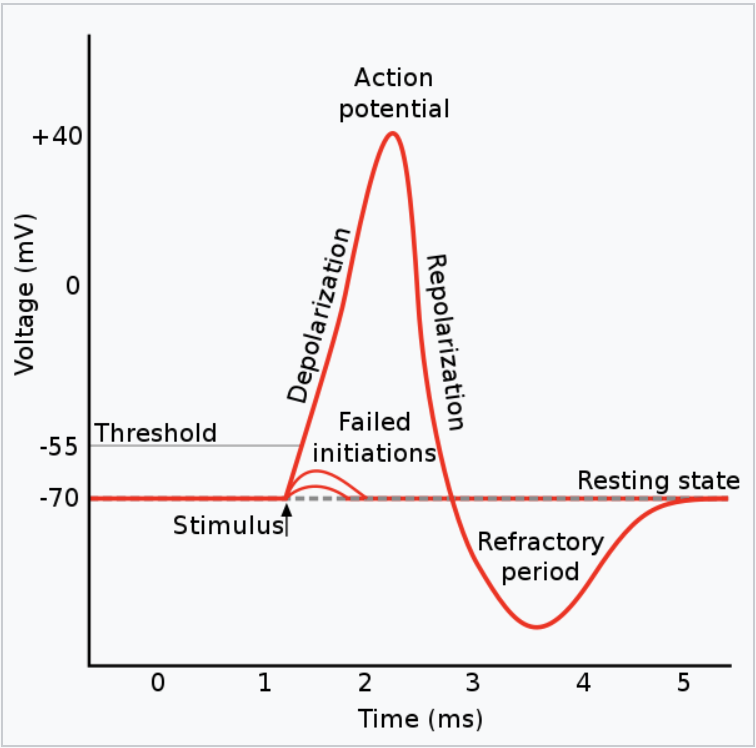
In practice, the phases of an action potential are:
- The stimulus causes sodium+ ions to rush inside the cell.
- This causes depolarisation.
- The potassium+ channels open, causing K+ ions to leave the cell.
- This causes repolarisation.
- The refractory period stabilises the density of ions.