A black and white image is essentially represented as a matrix of intensity values. There are different colour models for the representation of colour spaces. Namely, RGB and Y’CbCr.
As such, we represent this as: for an bit image s.t. .
Typical colour models for the representation of colour spaces are:
RGB Colour Space
The RGB model uses a 3-vector (R,G,B) to represent the permutations of these three colour units.
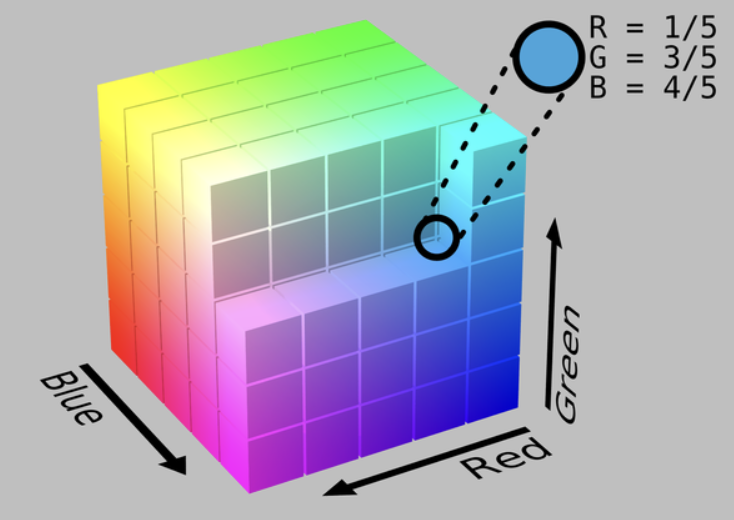
RGB is device-dependent; it is dependent on a camera’s colour filters.
Y’UV Colour Space
This model uses a 2-vector (U,V) to represent colour (chrominance) and a Y’ (luma) component to represent intensity.
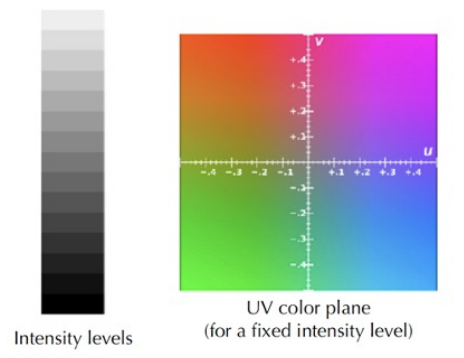
Originally, this was done to preserve compatibility between colour and BW television systems. In the modern day, a variant of this is commonly used, called Y’CbCr.
Y’CbCr Colour Space
The Y’CbCr model uses a 2-vector (Cb,Cr) to represent colour (chrominance) and a Y’ component (luma) to represent intensity.
This representation can be more useful for representing images, due to the ability to compress the image data without significant loss to quality, via chroma subsampling.
Other Representations
CMYK
The CMYK is a subtractive model, typically used for printing.

HSL
HSL uses hue, saturation & luminance to represent colour more intuitively.