ISO 31000 defines risk as the effect of uncertainty on objectives.
Below are some methods to mitigate risk.
Risk Identification
RACI
The Responsibility Assignment Matrix has the aim of ensuring accountability.
It should record who is:
- Responsible (at least one person, too many causes a turf war)
- Accountable (this should only be one person)
- Consulted (too many people slows it down)
- Informed (who to keep in the loop)
SWOT analysis
This is a matrix tool used to analyse internal and external factors affecting risk.
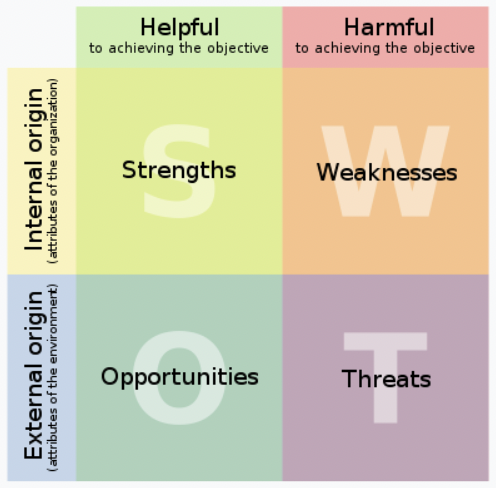 Other risk identification methods exist, such as the Risk Breakdown Structure.
Identifying Causes
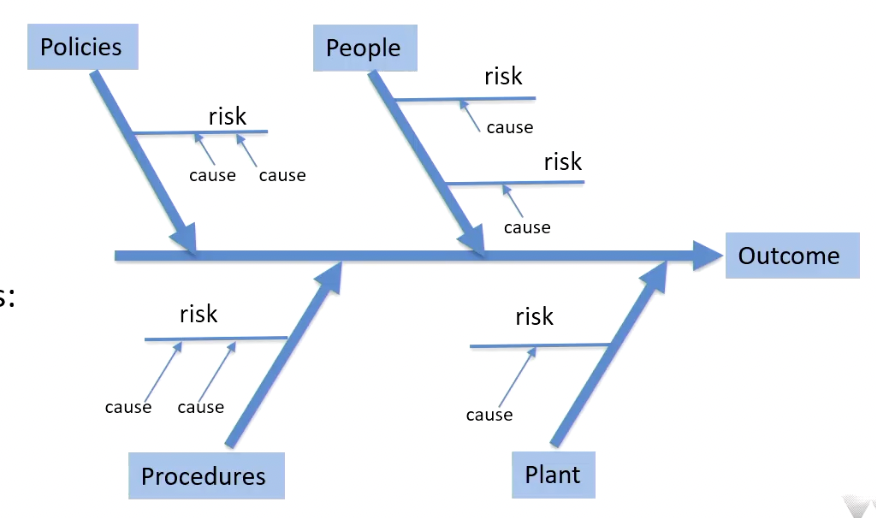
Ishikawa (Fishbone) Diagram
This diagram separates types of risks into groups (commonly the 4 P’s) and identifies the particular causes that may generate said risks.
Sensitivity Analysis
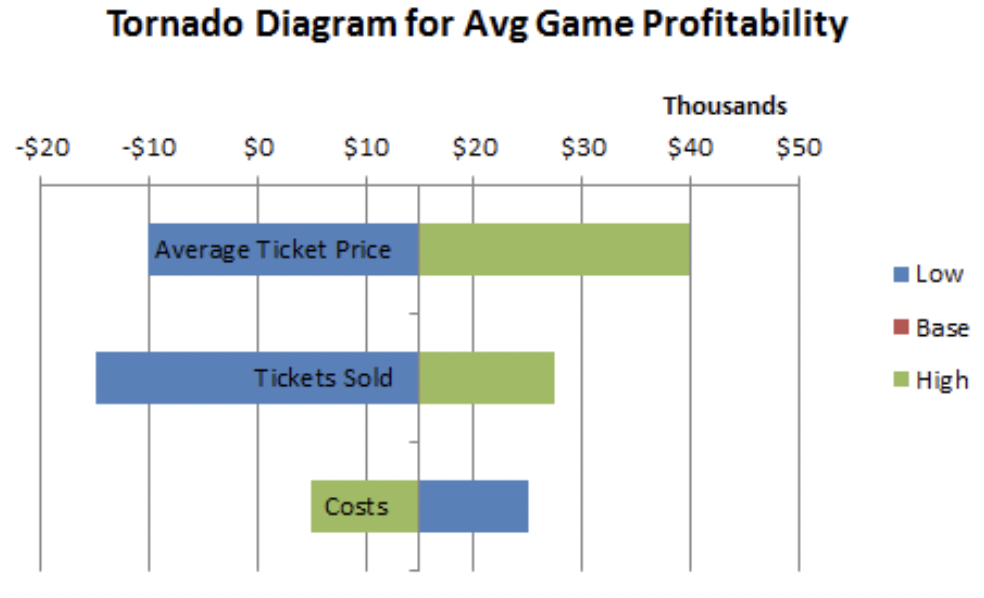
Loosely, sensitivity analysis is a tool to analyse how much dependent factors are affected by changes in the value of (typically, the variance of) related independent variables.
A deterministic method of conducting SA is by using a tornado diagram. This shows how the numerical range of each factor affects the end net value.
Responding to Risks
Risk Management Plan
This is a plan on handling risk; it describes the outcome in the event of the risk occurring - the risk response.
Generally, the aim is to categorise the risk into:
- Avoid (plan so it never happens)
- Control (reduce probability)
- Accept (respond quickly)
- Transfer (insure it)
Risk Matrix
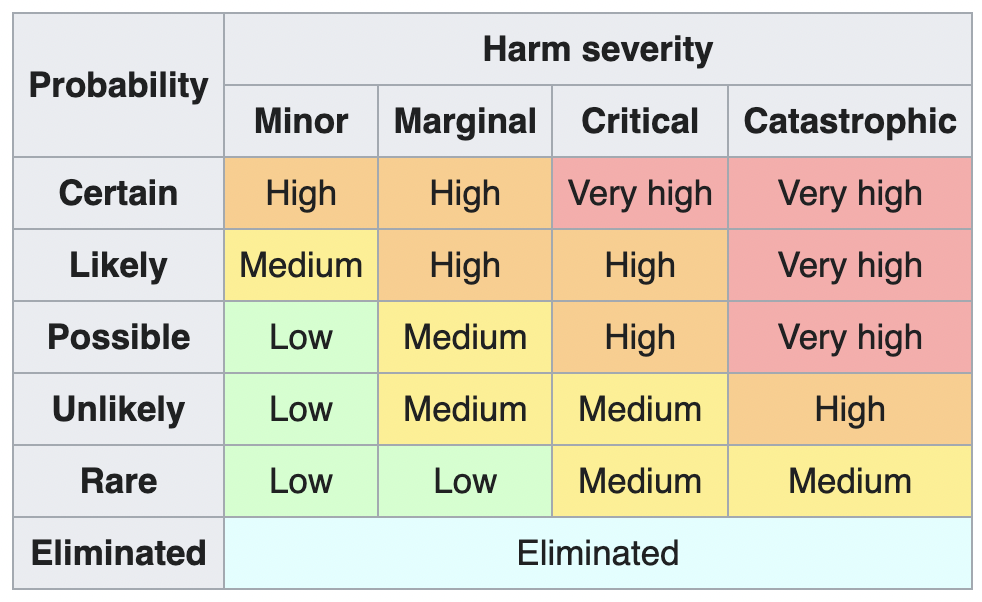
A risk matrix allows us to categorise risks according to impact (severity) and probability.
FMEA
Failure Modes & Effects Analysis is a method of finding what is likely to go wrong, and the intensity of the effect of it occurring.
Essentially, the severity, difficulty to detect & probability of occurrence are calculated, on a scale of 1-10. Then, Such that the Risk Priority Number, RPN, is the priority level of the risk. A larger number is a larger threat to the project.