An ad-hoc network is a collection of network devices without a fixed infrastructure (such as routers or access points) that wish to communicate.
Specifically, we note that not all nodes are able to directly communicate with each other.
A Mobile Ad-hoc Network (MANET) is comprised of devices that move freely (as such, cannot rely on fixed infrastructure).
Types
There are two types of topology for ad-hoc networks:
- Heterogenous networks consist of nodes with different capabilities
- Homogenous networks have nodes with identical features and capabilities
Use Cases
Environments which require rapid deployment such as:
- Military operational theatres
- Space exploration
- Temporary infrastructure networks
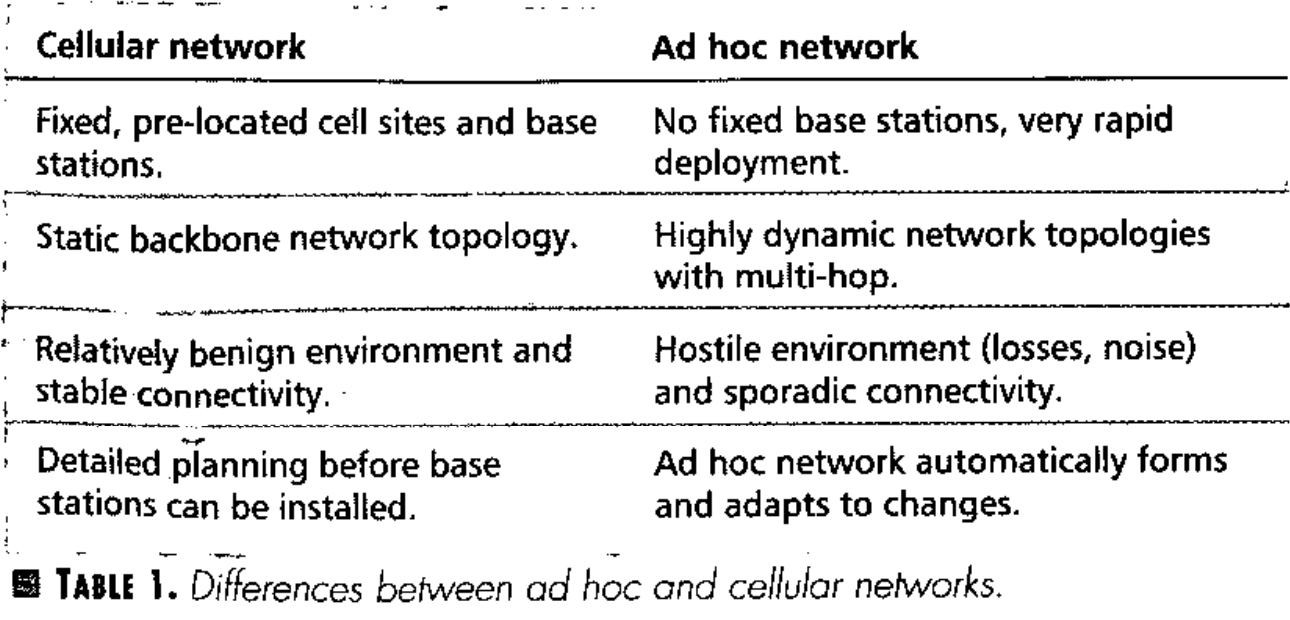
Whereas a cellular network relies on base stations and stable connectivity, mobile connections prioritise a sporadic, dynamic network, often in hostile or unfamiliar environments.
Issues
Scalability
This is defined as whether the ad-hoc network continues to provide an acceptable level of service for large numbers of nodes. This is often accomplished by using routing and location hierarchy within the network.
Power Sources & Energy Saving
Due to the lack of fixed infrastructure, nodes commonly rely on small, portable power sources. Hence, energy efficiency is vital. Most modern solutions rely on specific routing protocols.
Denial of Service Attacks
MANETs are vulnerable to DoS attacks as the comms medium is often insecure. The adaptable nature of an ad-hoc network means these attacks are often harder to track down.
Supporting Novel Technologies
Designing ad-hoc networks that can take advantage of modern communication and signal processing techniques, such as beamforming, have proven a challenge. In this case, most routing protocols have been designed for omnidirectional antennas, proving MANETs difficult to implement with beamforming.
Supporting Unmanned Systems
Unmanned systems commonly integrate several aspects of operation, such as networking, decision-making and movement. As such, a challenge is combining situational knowledge with the routing layer.
Physical RF Path Attenuation
Specifically, there is a lack of models surrounding how RF scattering occurs around real-life objects such as foliage or vehicles. The reduction in signal strength in physical environments due to interference is difficult to quantify.
Footnotes
Citation: A brief overview of ad hoc networks: challenges and directions - IEEE Communications Magazine (2002)