Carrier-Sense Multiple Access with Collision Avoidance is a transmission method which relies on the use of idle-checking for effective transmission.
Example Without Handshaking
Given the example network below, with arrows indicating a request for transmission:
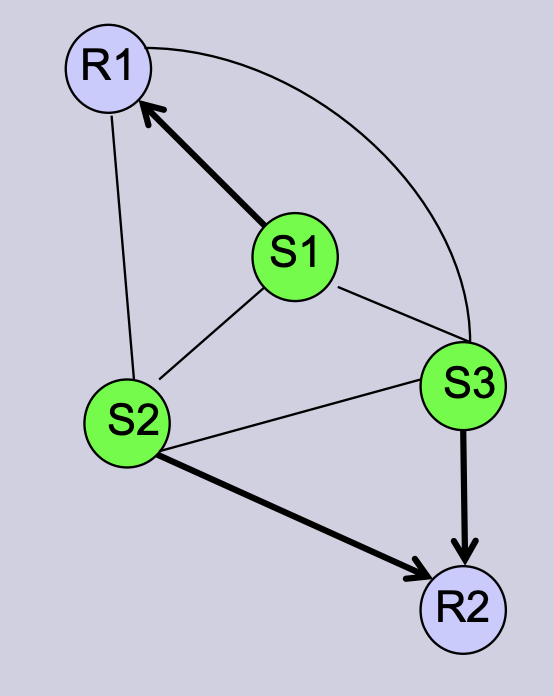
With transmission requests according to the table, assuming we have an inter-frame spacing (IFS) time of 2 and each packet takes 4 seconds to transmit:
| Node | Time Epoch |
|---|---|
| 0 | |
| 3 | |
| 5 |
We can note what occurs at each time interval as such:
| Event | |
|---|---|
| 0 | attempts to transmit, IFS window opens. |
| 2 | IFS window closes. Data begins transmission. |
| 3 | attempts to transmit but connection is busy. Fails. |
| 5 | attempts to transmit but connection is busy. Fails. |
| 6 | transmission ends. |
At this time interval, the contention window opens. This is when all transmissions that have been forced to wait get assigned a random position aligning to back-off time before transmitting. In the case where and pull a time of 4 and 5 respectively, we have:
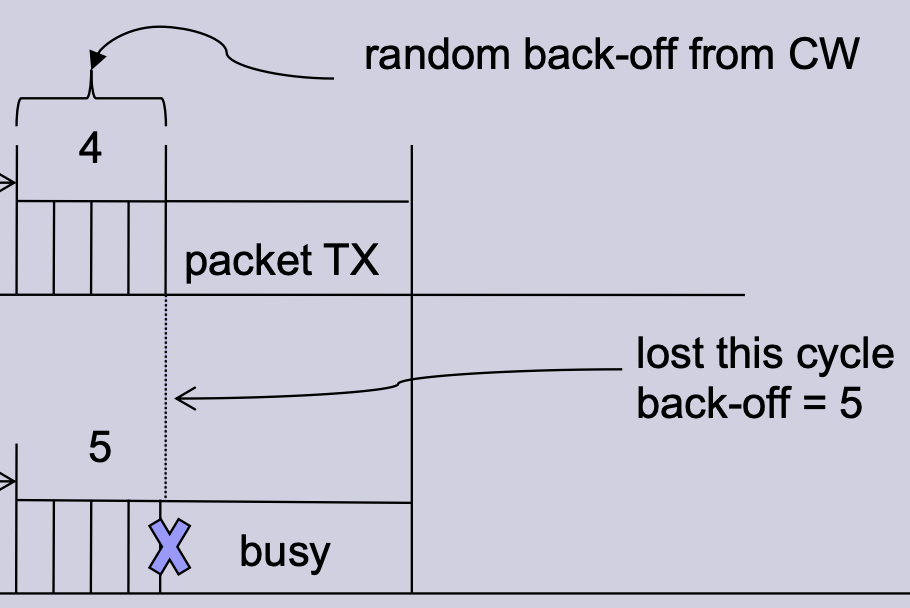 After this contention window closes, another will open.
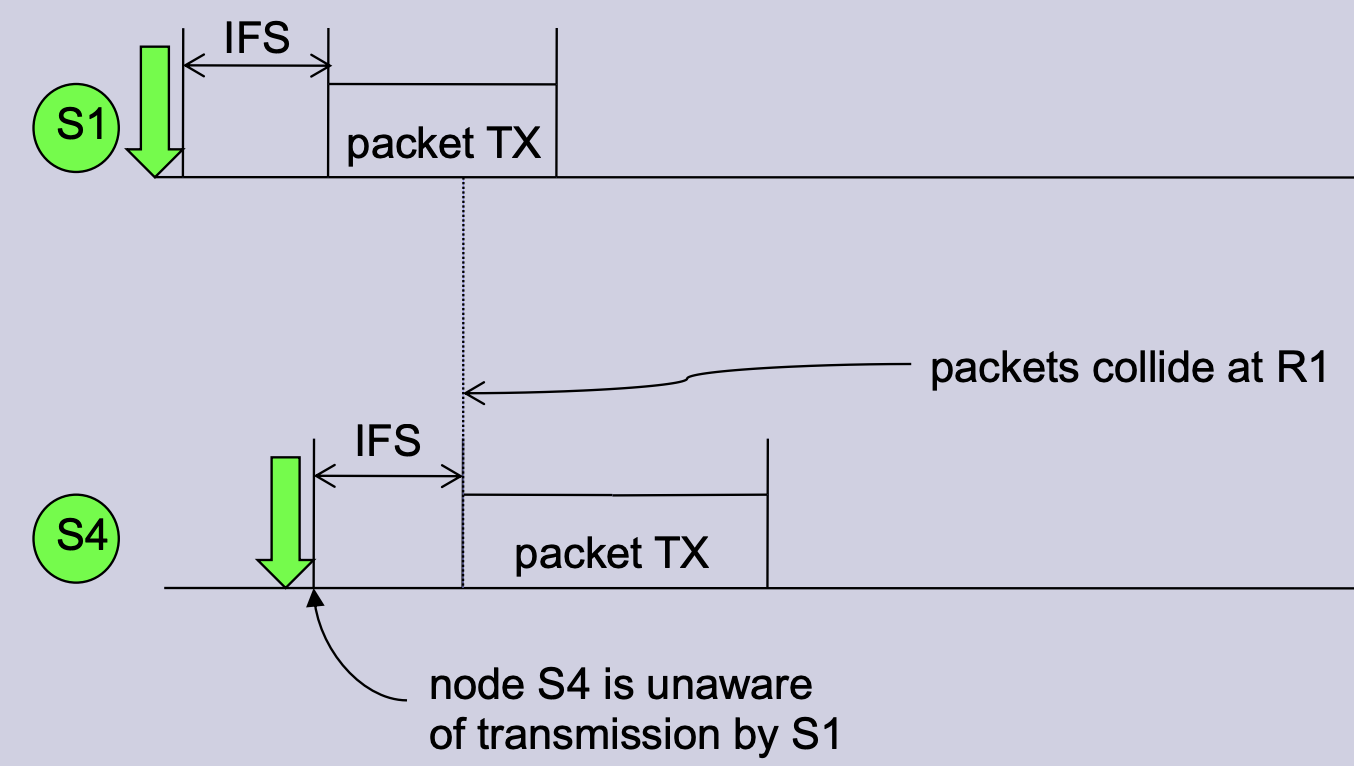
Issue: The Hidden Node Problem.
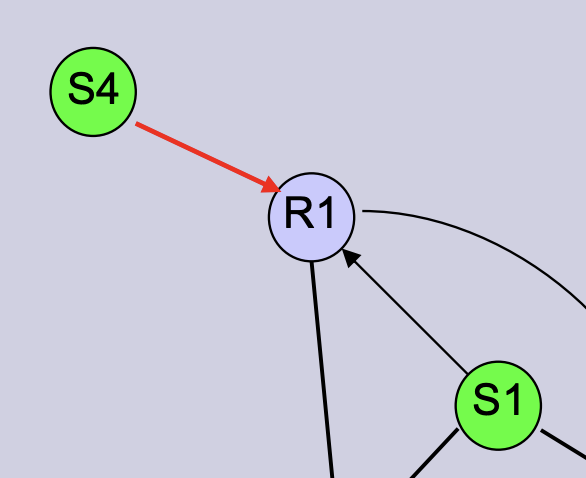
If two nodes aren’t communicating but are both requesting to transmit a packet, a collision will occur:
Handshaking
We need handshaking to solve the Hidden Node Problem.
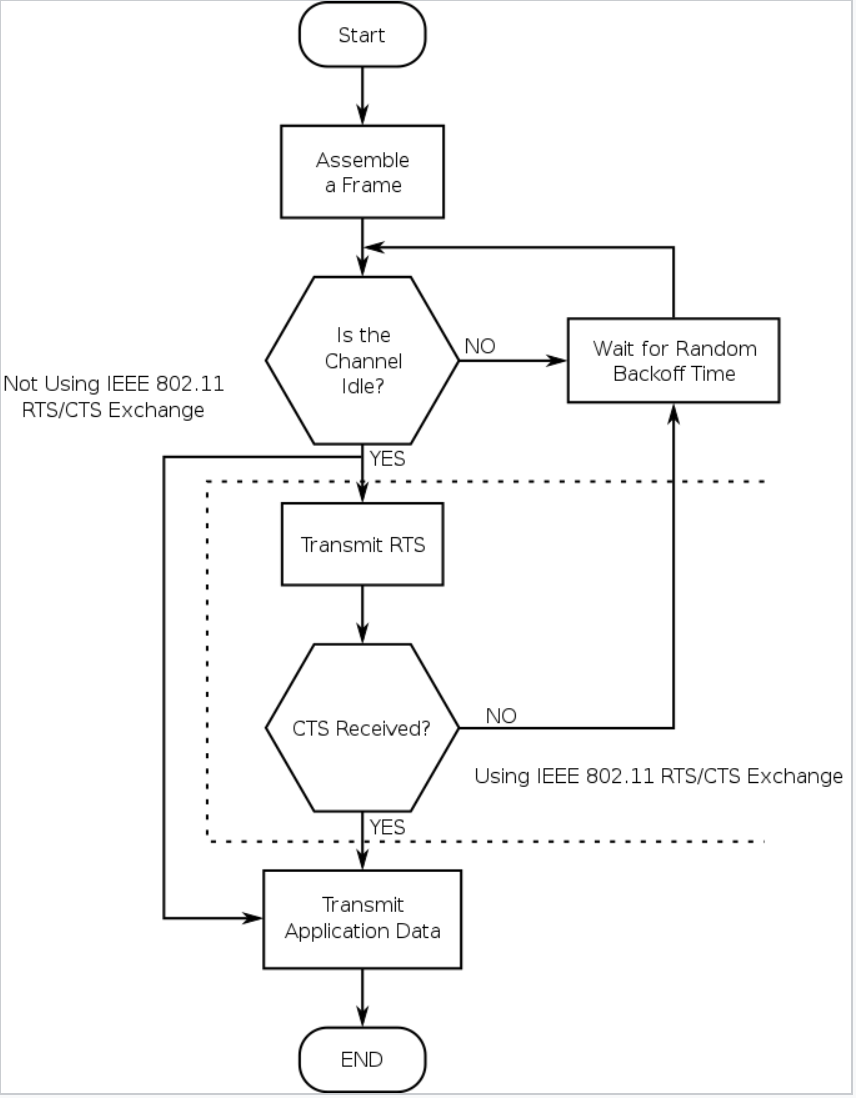
Transmitter
Essentially, the node requesting to transmit does two things:
- If the channel is idle, transmit an RTS, else, wait.
- If a CTS is received, transmit data, else, wait.
Receiver
- The receiver waits for an RTS. It responds to it with a CTS unless one has already been sent.
- Once the packet is transmitted, it sends an ACK to notify the network that the channel is clear.
How does handshaking solve the Hidden Node Problem?
Essentially, only one packet can be successfully transmitted at a time, once a CTS is received.