Cloning (or copy-move) forgery is a type of image forgery, akin to the ones found within Compression Forensics. It consists of a part of an image being cloned and moved elsewhere in the image.
Detection
We may consider a few simple methods:
- Use Compression Forensics to detect changes in compression throughout the image.
- Perform an exhaustive search across the image for similar blocks.
Exhaustive Searching
We can iterate in both dimensions, whilst circularly shifting the image and check for duplicate regions (namely, regions that have a similarity value above a determined threshold).
Following this, false positives may exist. As such, we perform:
- Erosion, removing negatively matched neighbours.
- Dilation, matching unmatched neighbours. This results in the strongest connections being strengthened and the weak matches being eroded.
We can output the image with the tampered region as bright pixels.
Pixel Domain Block Matching
We can use a sliding window and a similarity metric.
In practice, we can use a feature extraction algorithm to ‘score’ a block, then sort these blocks lexicographically.
We can then identify similar blocks as ones that are lexicographically very similar (their difference is below a threshold).
Frequency Domain Block Matching
We can utilise the Cosine Transform coefficients and iterate over blocks of coefficients. The general idea is that blocks with very similar frequencies may be cloned.
Advanced Feature Extraction
We may also use more advanced methods to characterise features in an image, to determine similarity.
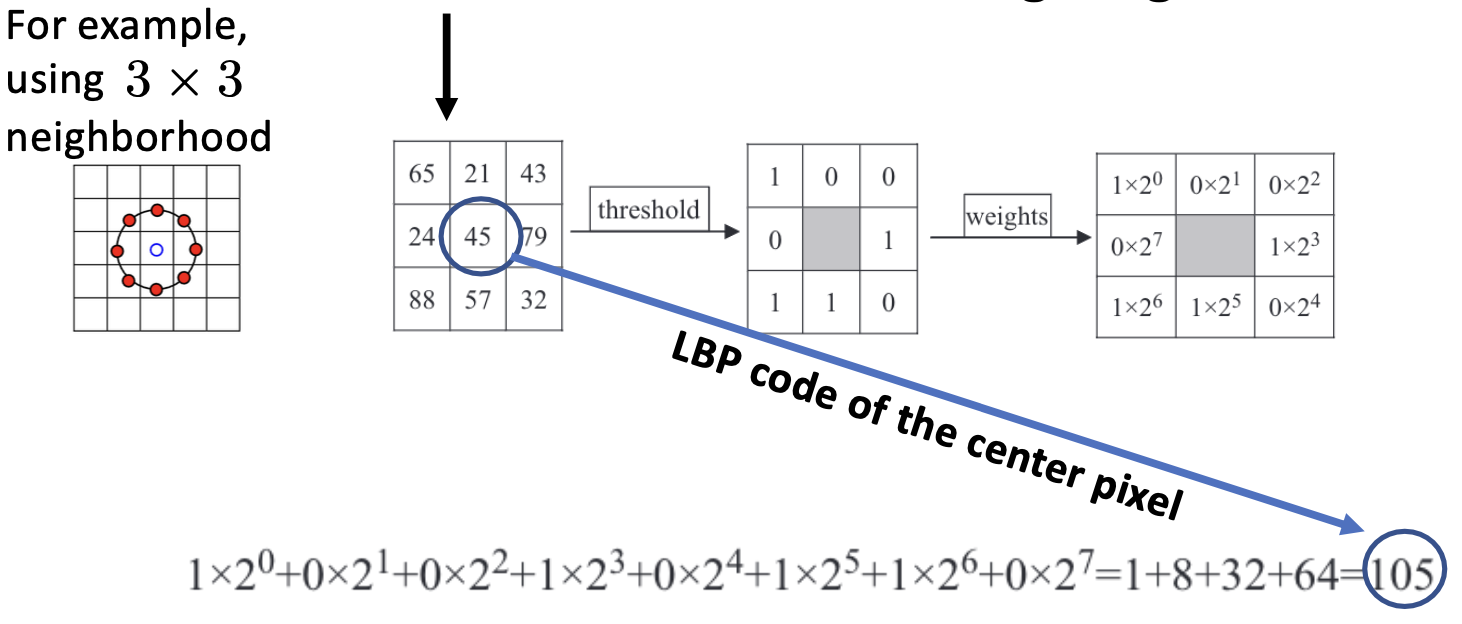
Local Binary Pattern
LBP is useful for texture extraction.
We generate a pixel neighbourhood and check the pixel intensities of the neighbourhood. This ensures rotation and scaling invariance.
Histogram of Oriented Gradients
We can use Gradient Edge Detectors as masks to determine gradients in an image (for example, for edge detection).
We can then generate a histogram of the gradient values, with the bins corresponding to the angle of the gradients.