A sensor node or mote is an individual node of a sensor network capable of handling and processing data and performing desired actions.
It typically consists of:
- Microcontroller
- Transceiver
- Power Source
- Memory Unit
- Sensors
Sensor nodes can be modelled using a four-layer stack:
Application
Network
The network layer is responsible for packet forwarding by routing.
Data
The data layer is concerned with transmissions. For our specific purposes, we will consider that nodes are half-duplex so can either transmit or receive at any given time, but not both. As such, methods of transmission are usually governed by Medium Access Control protocols and multiple access methods. One such method is CSMA-CA.
We’ll characterise two main issues. The Hidden Node Problem and the Exposed Node Problem.
Physical
The role of the physical layer is to convert binary or analog data into signals suited for wireless transmission.
Operation
Data is taken from the upper layer and passed through a modulator to convert it:
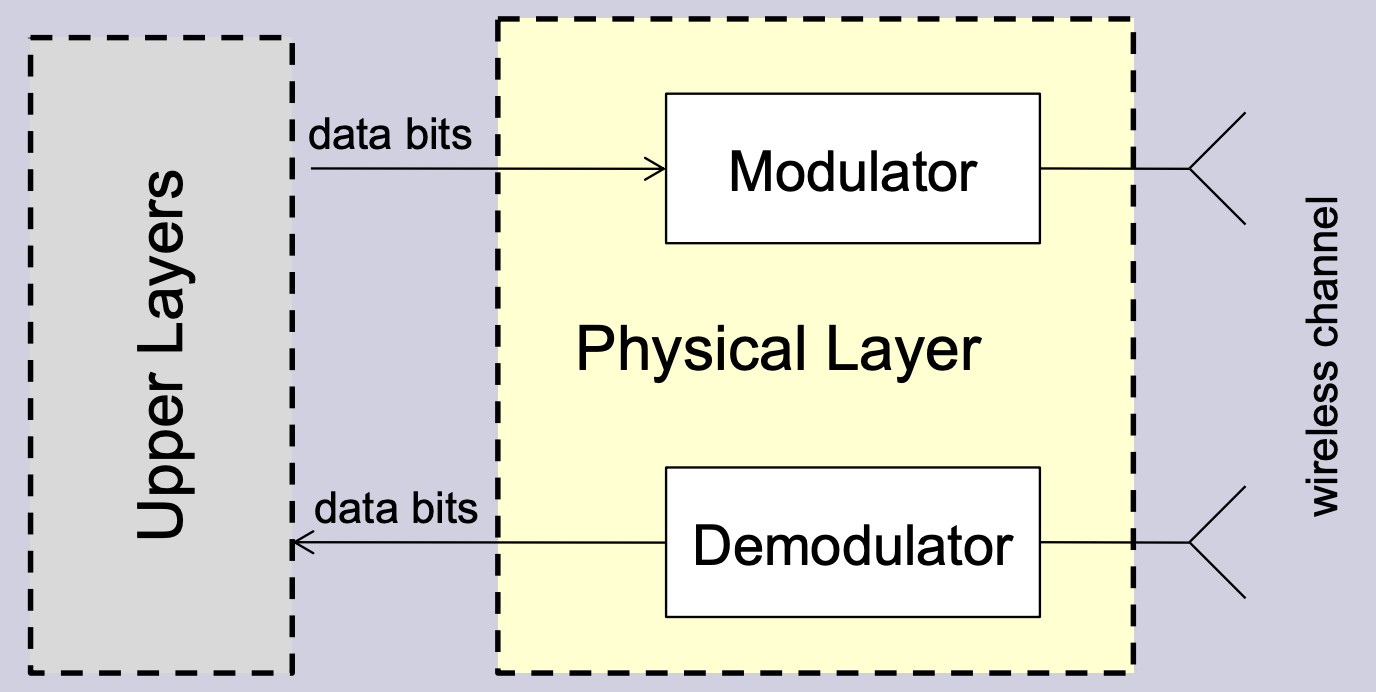
Communications typically employ electromagnetic waves. The bandwidth determines the transmission capacity, , such that: for bandwidth and signal-to-noise ratio . Typically, transmission occurs over the ISM band, commonly .
When data needs to share a medium, multiplexing can be implemented.
Issues
Electromagnetic waves suffer from four main effects which affect signal transmission.
Path Attenuation
Primarily, signal strength decreases as a function of distance. A node’s transmission range is the specific maximum distance at which the node’s receiver is still sensitive enough to receive incoming transmissions.
Reflection & Refraction
EM waves bounce (reflect) off of or refract across a medium’s boundary. This may change the direction, strength and characteristics of the signal.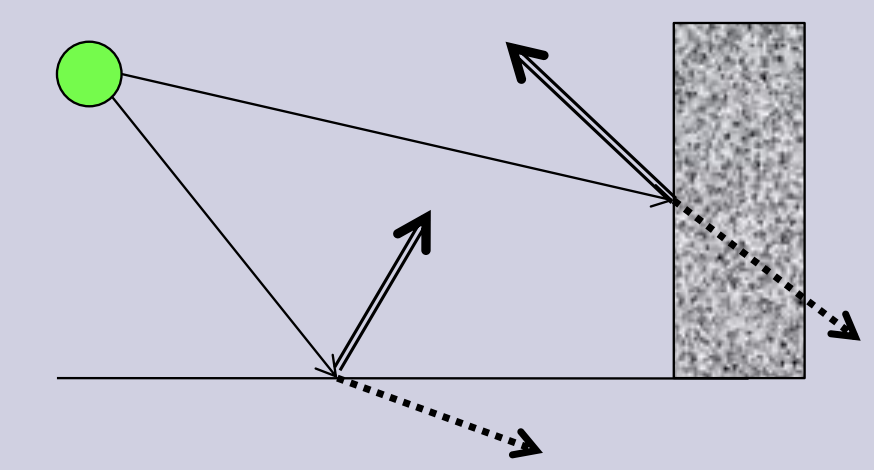
Diffraction
When EM waves propagate through a sharp edge, they may diffract, splitting the signal into several weaker instances of itself.
Scattering
EM waves may scatter when incident to a rough surface, splitting and changing direction.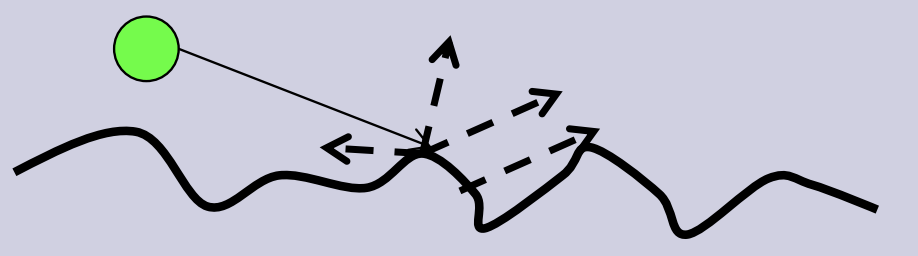
Doppler Fading
Another well known issue is that of doppler fading. Due to the Doppler Effect, moving nodes undergo a shift in frequency. We note that:
- A signal being transmitted over a distance that is shrinking (such as when the objects are moving closer together) will show a relative increase in frequency.
- Conversely, over an increasing distance, we note a relative decrease in frequency.
Error Detection & Correction
There are two common simple methods of error detection: Parity bits and Checksums. These both modify the initial data but do not provide a method of locating or correcting errors.
To combat these, Forward Error Correction techniques can be used, as well as Spread Spectrum techniques.