This approach utilises a wave transform, to convert between the spatial domain and frequency domain, in order to reduce noise in a specific frequency.
There are two main approaches:
- Fourier Transform
- Cosine Transform Converting to the frequency domain results in a frequency spectrum. Typically, most noise appears in the high-frequency channels. Hence, we can use a mask to reduce noise at a specific frequency.
Simple Mask
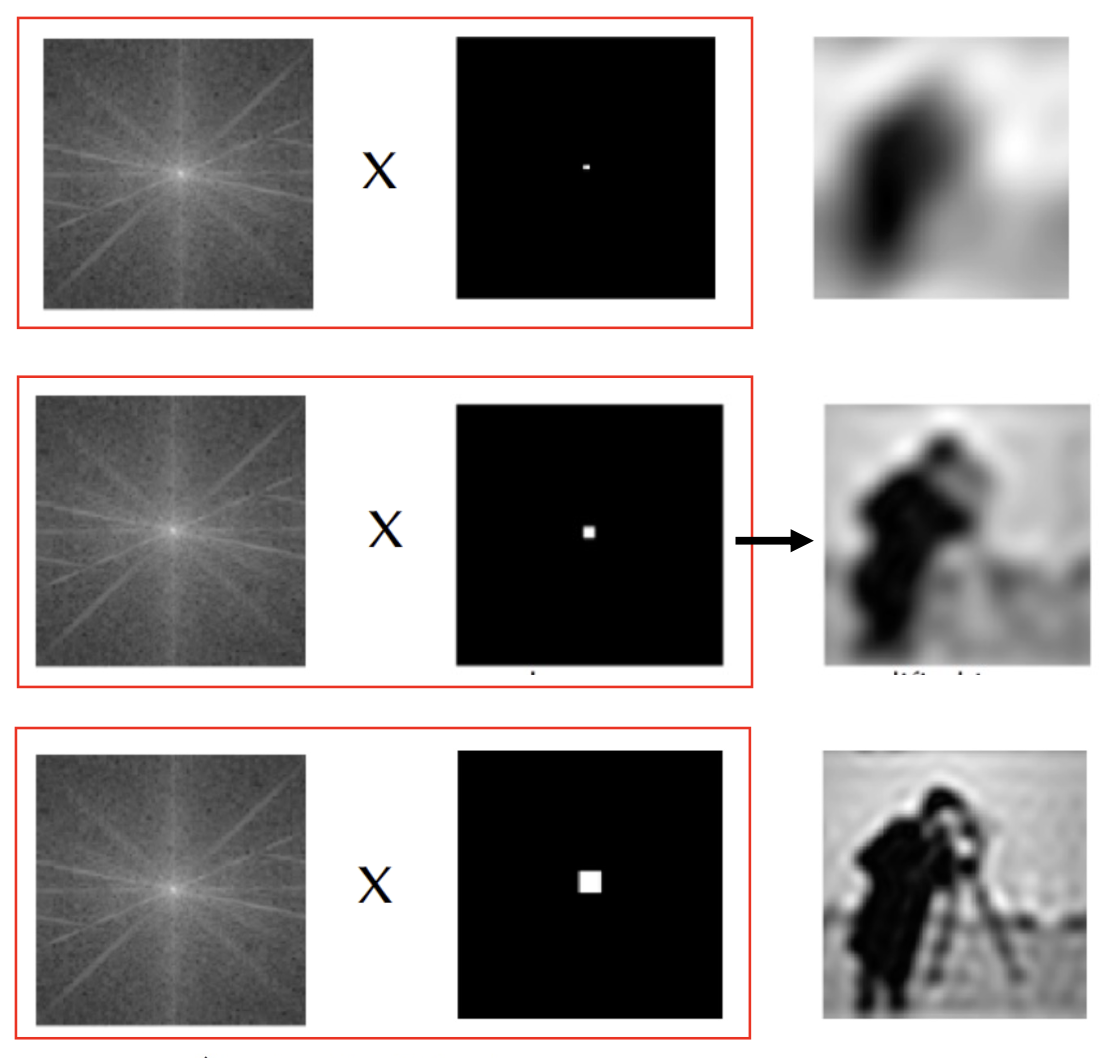
We can design a simple mask centred around the origin of a frequency spectrum, which preserves all of the given frequency information below a given threshold.
Some examples are seen below.
Ideal Low Pass Filter
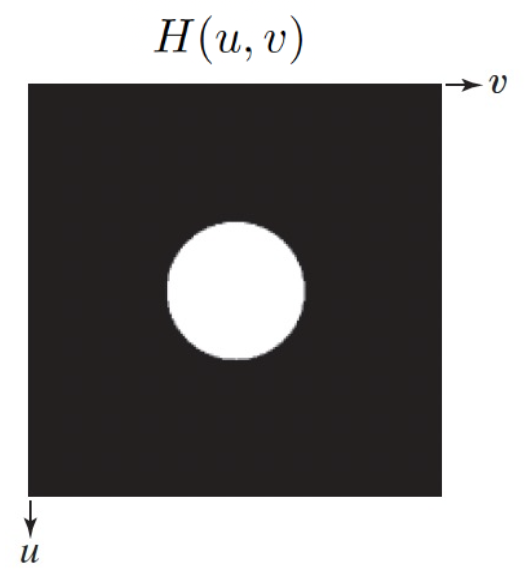
The Simple Mask can be extended to a low pass filter, which is a circle with radius , centred around the origin of the frequency spectrum.
Gaussian Low Pass Filter
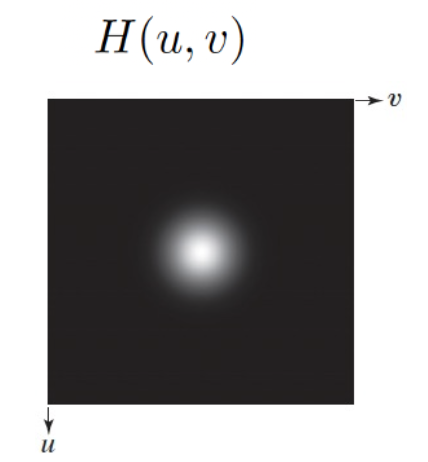
The GLP Filter extends the Ideal Low Pass Filter by using a Gaussian Distribution as a noise model. This means the least noisy frequencies are kept, with a decreasing influence as the frequency increases.
Butterworth Low Pass Filter
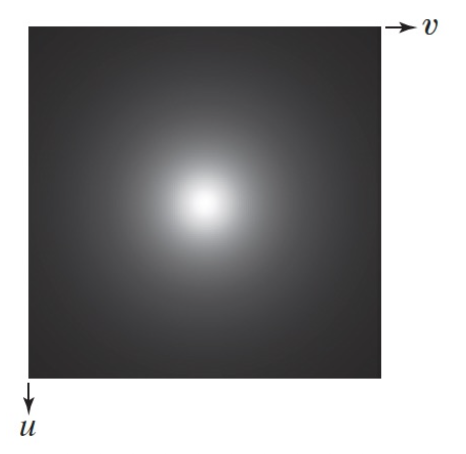
This is similar to the Gaussian Low Pass Filter, with a parameter controlling the steepness of the cut-off range. It can result in a wider low pass space.
The equation for this relationship is:
High Pass Filter
Any low pass filter can be inverted to create a high pass filter.
Notch Filter
Notch filters are used to remove repeated (pattern) spectral noise from an image.