Due to the human vision system’s lower acuity for colour differences compared to luminance, images can be encoded by implementing less resolution for chrominance information, whilst keeping the luma information fixed.
Consider a ratio: Such that we have:
- , the width of the region undergoing subsampling.
- , the number of chroma samples in the first row () pixels.
- , the number of changes of chroma samples between the first two rows.
Example
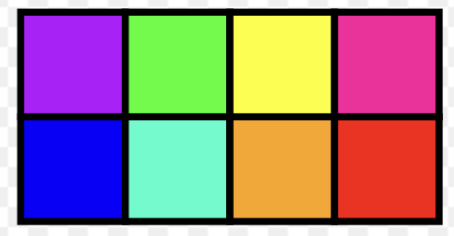 The above image has width 4. There are 4 samples in the first row. Looking at each column, we see the chrominance changes for each column.
Hence, we have the subsampling ratio .
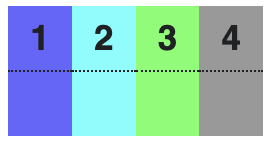 The above image has width 4. There are 4 samples in the first row. Looking at each column, the chrominance never changes between the first two rows.
Hence, we have the ratio .
To get chrominance values for each pixel after subsampling, we can use a range of averaging methods. Typical ones are:
- Naive Average
- Left (average of leftmost 2 pixels)
- Right (average of rightmost 2 pixels)
- Direct (top-left value)