Watermarking is the process of modifying an image so that authenticity or tampering can be demonstrated. It is part of Forgery Detection. As with Image Enhancement, watermarking can occur in both the pixel domain and frequency domain.
Watermarks can be:
- Robust - designed to survive all modifications
- Fragile - designed to detect (and be susceptible to) unauthorised modifications.
Also:
- Visible
- Invisible, specifically such that the watermark is hidden in pixel data.
Operation
Watermarking follows the encoder-decoder structure.
This means the original image is combined with a signature using an encoder.
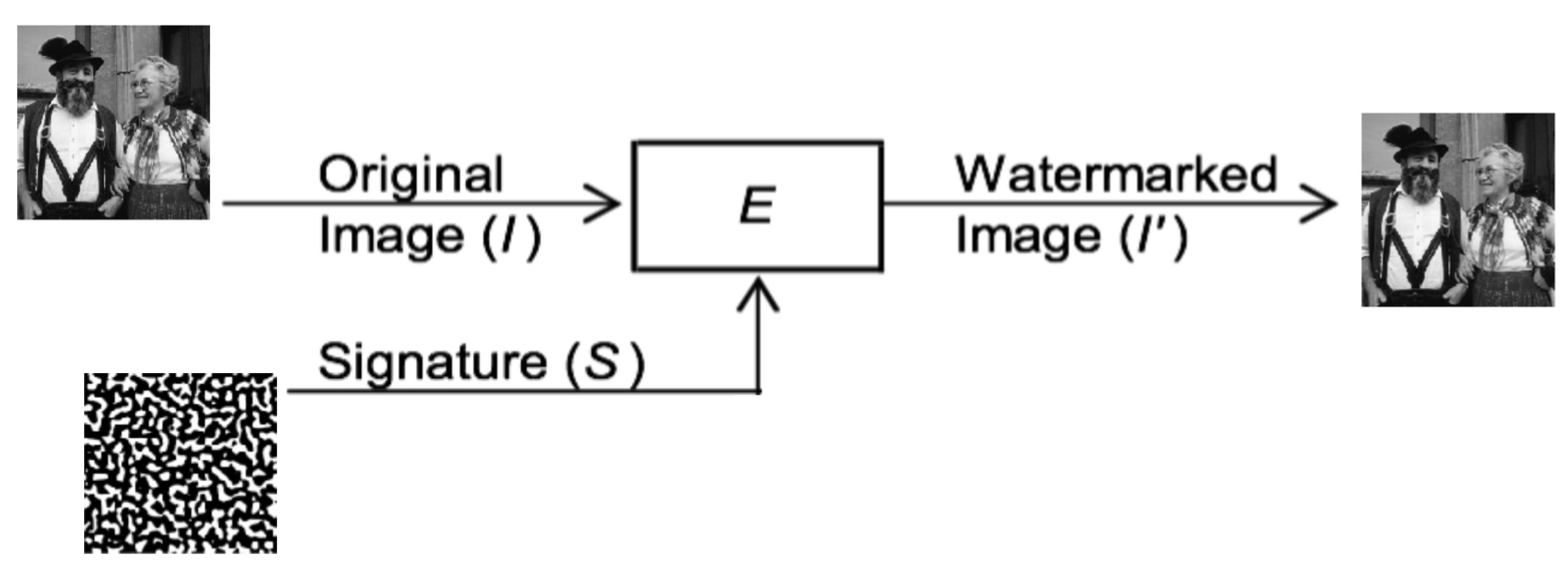
The signature can then be extracted using a decoder.
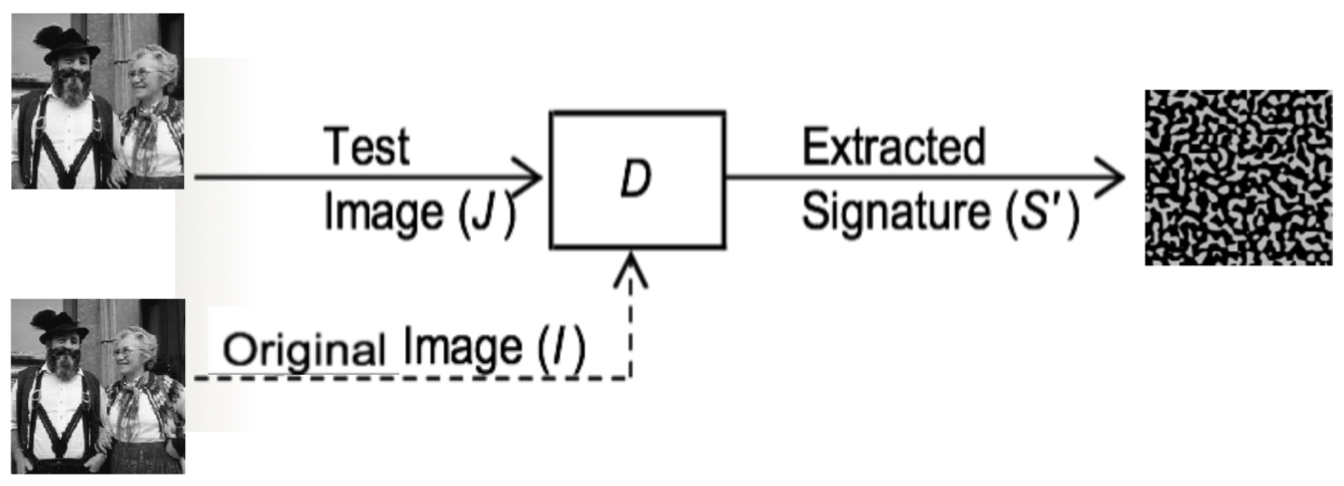
If a comparison is necessary, a comparator can be used to compare the original signature and decoded signature for a match.
Applications
Ownership Claiming
The owner of an image can embed a visible watermark to prevent others from using it. This is most commonly seen in stock image databases.
Ownership Identification
The owner of an image can embed an invisible watermark, such that, if any other user were to claim ownership, the real owner can prove ownership via the watermark.
Copy Detection
The owner of an image can embed unique invisible watermarks when sharing the image to distinct users. If a copy is made, the watermark on the copy can be used to determine the user that created the copy.
Tamper Detection
If an image is tampered with, the watermarks of the modified image and the original can be compared.